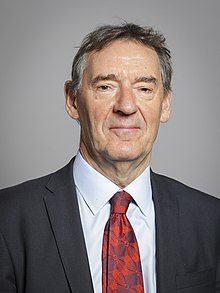
Terence James O'Neill, Baron O'Neill of Gatley (born 17 March 1957)[1] is a British economist best known for coining BRICs, the acronym that stands for Brazil, Russia, India, and China—the four rapidly developing countries that have come to symbolise the shift in global economic power away from the developed G7 economies.[2] He is also a former chairman of Goldman Sachs Asset Management and former Conservative government minister. As of January 2014, he is an Honorary Professor of Economics at the University of Manchester.[3] He was appointed Commercial Secretary to the Treasury in the Second Cameron Ministry, a position he held until his resignation on 23 September 2016. He chaired the UK's Independent Review into Antimicrobial Resistance for two years, which completed its work in May 2016.[4] Since 2008, he has written monthly columns for international media organization Project Syndicate.[5] He is the current chairman of the Council of Chatham House, the Royal Institute of International Affairs.
Career
Economic views
O'Neill claims not to commit to a specific financial ideology; instead, he is known for his "pragmatic, long-term" vision of currency markets. He improves upon traditional models of data analysis by incorporating elements that ultimately make them more accurate.[23]
BRICs
O'Neill coined the term "BRIC" in 2001 in "The World Needs Better Economic BRICs", a paper written for Goldman Sachs's "Global Economic Paper" series, on the four emerging "BRIC" economies Brazil, Russia, India, and China.[24]
Foreign exchange markets
O'Neill has been called a "currency guru"; he has been hailed as "the top foreign-exchange economist anywhere in the world in the past decade". For example, in 2004 he accurately predicted that the euro would rise from $1.25 to $1.30 a year later; he was also right about the yen's rise in the mid-1990s.[23] He was previously head of global economic research and commodities and strategy research at Goldman Sachs.[25]
Next Eleven
The Next Eleven (known also by the numeronym N-11) are the eleven countries – Bangladesh, Egypt, Indonesia, Iran, Mexico, Nigeria, Pakistan, Philippines, South Korea, Turkey and Vietnam – identified by Jim O'Neill in a research paper as having a high potential of becoming, along with the BRICS countries, among the world's largest economies in the 21st century.[26] The bank chose these states, all with promising outlooks for investment and future growth, on 12 December 2005.
The criteria used were macroeconomic stability, political maturity, openness of trade and investment policies, and the quality of education. The N-11 paper is a follow-up to the bank's 2003 paper on the four emerging "BRIC" economies.[27][28]
MIKT
In 2011, O'Neill coined the term MIKT (MIST is also used) for the countries of Mexico, Indonesia, South Korea, and Turkey.[29][30][31][32][33] The term has largely fallen out of use, having been replaced by MINT (see below).
MINT
In 2013, O'Neill also coined the term MINT—Mexico, Indonesia, Nigeria, and Turkey—in order to differentiate among the variety of emerging economies.[34] He plans to group this quartet as "growth markets" within the overall BRIC nations. In January 2014, O'Neill presented a four-part documentary series on this subject for BBC Radio entitled MINT: The Next Economic Giants.[35]
Personal life
O'Neill grew up in Gatley and attended Burnage Comprehensive and Sheffield University, where he studied economics.[36] O'Neill is a huge football fan and played for the Bank of America's first team in London. He is a lifelong fan of Manchester United F.C. and served as a non-executive director from 2004 to 2005, before the club was returned to private ownership.[37] On 2 March 2010, the Red Knights, a group of wealthy Manchester United fans believed to include O'Neill, confirmed interest in a possible takeover of the club.[38]
This article uses material from the Wikipedia article
Metasyntactic variable, which is released under the
Creative Commons
Attribution-ShareAlike 3.0 Unported License.